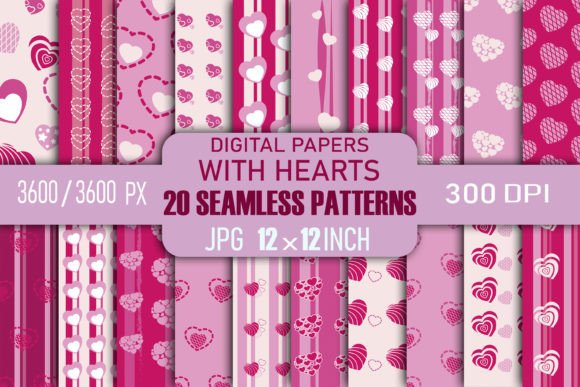
Seamless Patterns with Hearts Design: A Versatile Digital Resource for Creative Professionals and Hobbyists
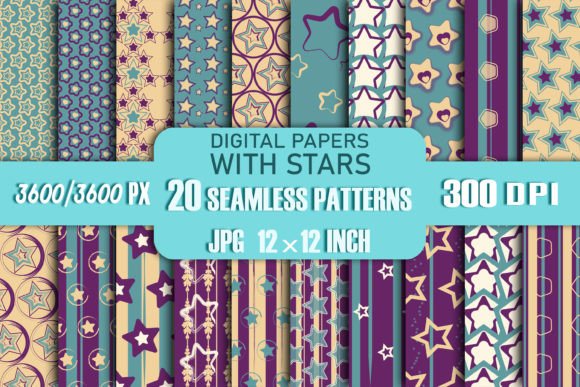
Seamless Patterns with Hearts Design represent more than just decorative motifs—they are functional, scalable, and deeply adaptable digital assets rooted in timeless visual language. At their core, these patterns combine the emotional resonance of the heart symbol with the technical precision of repeatable tiling geometry. The 20 Seamless Patterns – digital paper with hearts design collection exemplifies this balance: each pattern is crafted to tile infinitely without visible seams, rendered at 300 dpi resolution, and sized precisely at 12 × 12 inches (3600 × 3600 pixels). This specification isn’t arbitrary—it reflects industry standards for high-fidelity printing and digital scalability across diverse output formats.
Why Resolution and Dimension Matter in Practice
A 300 dpi resolution ensures crisp rendering when printed on physical media—whether that’s letterpress stationery, fabric swatches, or laminated planner covers. Unlike web-optimized images (typically 72 dpi), 300 dpi files retain clarity even when enlarged or cropped tightly during layout refinement. The fixed 12 × 12 inch canvas further supports consistency: designers can preview how a pattern behaves across standard craft sheet sizes, notebook covers, or A4/A5 print layouts without distortion or interpolation artifacts. This predictability reduces trial-and-error in production workflows—especially valuable for educators preparing classroom handouts, small-batch entrepreneurs designing product labels, or scrapbookers assembling layered digital albums.
Real-World Applications Across Disciplines
The versatility of Seamless Patterns with Hearts Design emerges most clearly when observed across distinct use cases—not as abstract possibilities, but as documented practices.
- Invitations & Stationery: Wedding or baby shower invitations benefit from subtle heart-based repeats that convey warmth without overwhelming typography. A low-contrast watercolor heart pattern, for instance, serves as elegant background texture behind serif headings—enhancing readability while reinforcing theme.
- Apparel & Wearables: T-shirt designers apply these patterns to mockups using clipping masks in design software. Because each JPEG is seamless, scaling the pattern to fit full-front chest prints or sleeve wraps requires no manual tiling—saving hours per design iteration. Nail wrap creators similarly use the same files to generate precise cut lines for UV-cured overlays.
- Educational Materials: Teachers integrate heart-patterned borders into printable worksheets for early literacy units, leveraging visual familiarity to support focus in young learners. The consistent rhythm of repetition also aids students with sensory processing differences by providing predictable spatial cues.
- Digital Product Development: Website designers embed these patterns as CSS background images (via data URIs or optimized CDN delivery) for hero sections or section dividers. Their 3600 × 3600 px dimensions allow responsive cropping across breakpoints—no pixelation on retina displays or large-format kiosks.
- Physical Craft Production: Bottle cap artisans print scaled-down versions onto adhesive-backed vinyl, then die-cut them to match standard 1-inch cap diameters. Journal cover makers use the full 12 × 12 inch file to wrap hardcover spines and boards, ensuring pattern continuity across fold lines—a detail customers notice and appreciate.
Design Characteristics That Enable Broad Utility
What distinguishes this set from generic heart-themed clipart or low-resolution downloads? Three interlocking qualities:
- True Seamlessness: Each pattern undergoes manual edge alignment verification—not algorithmic auto-tiling. This means no ghost lines, no misaligned strokes, and no color shifts at tile boundaries. When repeated across a 24-inch wide planner cover, the transition remains invisible to the naked eye.
- Intentional Visual Hierarchy: Within the 20 designs, variation exists not just in motif style (line art, watercolor blot, geometric tessellation, stippled silhouette), but in density, contrast, and negative space distribution. One pattern may feature widely spaced minimalist hearts ideal for text-heavy layouts; another uses tightly packed vintage-inspired outlines suited for textile printing where thread count limits fine detail.
- Format Discipline: Delivery as individual JPEGs—rather than layered PSDs or vector EPS—ensures universal compatibility. Users on Linux-based illustration tools, iPad Procreate workflows, or Windows desktop publishing suites all open and place files without conversion friction. The zip container further simplifies bulk import into cloud storage or asset management systems used by design teams.
User-Specific Considerations and Workflow Integration
Different users interact with Seamless Patterns with Hearts Design in ways shaped by their tools, constraints, and goals.
For Print-on-Demand Sellers: These files integrate directly into platforms like Printful or Gelato. Upload a single JPEG, assign it to a product variant (e.g., “Heart Grid – Navy” for a phone case), and rely on automated bleed and trim handling—no need to pre-extend edges or adjust DPI settings manually.
For Educators and Nonprofits: The absence of licensing restrictions (beyond standard commercial use terms) allows embedding in publicly shared lesson plans or community event flyers. A library hosting a Valentine’s Day craft workshop might project a heart pattern onto a wall as a tracing guide—its 300 dpi fidelity ensures clean projection even at 8-foot width.
For DIY Makers and Hobbyists: The JPEG format supports direct import into Cricut Design Space or Silhouette Studio. Adjusting scale to match vinyl roll widths (e.g., 12 inches) preserves proportionality—critical when cutting intricate heart outlines for decal applications. No vector conversion step introduces rounding errors or path simplification that degrades delicate linework.
Technical Observations Beyond Marketing Claims
While many digital paper collections claim “high resolution,” few specify how that resolution functions in practice. In this set, 300 dpi is maintained *at the native 12 × 12 inch dimension*. Some competitors deliver 300 dpi files at smaller base sizes (e.g., 6 × 6 inches), forcing users to upscale—introducing interpolation blur. Others provide vector files that rasterize poorly at certain print resolutions due to embedded raster effects. This collection avoids both pitfalls through intentional raster optimization.
Color fidelity is preserved using sRGB color space—the web and print industry standard—ensuring consistent appearance whether viewed on an OLED monitor or offset-printed on uncoated stock. No embedded profiles cause unexpected shifts in CMYK conversion; designers retain full control over ink mapping during prepress.
Expanding Creative Possibilities Without Adding Complexity
One underdiscussed advantage of curated pattern sets like Seamless Patterns with Hearts Design lies in cognitive load reduction. Instead of sourcing, editing, and testing dozens of disparate heart motifs, users gain immediate access to 20 cohesively styled options—each tested for real-world performance. A jewelry designer sketching pendant backs can cycle through five subtle tone-on-tone patterns in under two minutes, comparing how each interacts with metal finish samples. A researcher compiling a presentation on symbolic motifs in contemporary design can use the patterns as consistent visual anchors across slides—strengthening narrative cohesion without diverting attention to formatting.
This efficiency scales. A small business owner launching seasonal greeting cards doesn’t need to commission custom illustrations for every release. Instead, they rotate between heart patterns aligned with thematic palettes—rose gold foil over a metallic-dot heart repeat for holidays, sage green over linen-textured hearts for spring—maintaining brand recognition while refreshing visuals annually.
Implementation Notes for Long-Term Value
To maximize utility over time, consider these practical steps:
- Organize by Use Case: Rename files descriptively (e.g., “hearts_watercolor_soft-12x12_300dpi.jpg”) rather than relying on generic numbered labels. This speeds retrieval during tight deadlines.
- Test Print Early: Before committing to bulk orders, print one pattern on your target substrate—kraft paper, cotton duck cloth, or glossy photo paper—to verify how halftone dots or fiber texture interact with heart outlines.
- Adapt for Accessibility: When using patterns behind text, verify contrast ratios using tools like WebAIM’s Contrast Checker. Some delicate watercolor hearts may require lightening or overlaying a semi-transparent layer to meet WCAG 2.1 AA standards.
- Leverage Metadata: Embed copyright and usage notes in file properties—not just in external documentation. Most design software reads XMP metadata, helping teams maintain compliance across distributed projects.
Ultimately, Seamless Patterns with Hearts Design succeed not because they contain hearts—but because they solve tangible problems: reducing production friction, supporting inclusive design decisions, enabling cross-platform consistency, and honoring the craftsmanship expected by discerning creators. Whether applied to a hand-bound sketchbook cover or a globally distributed mobile app interface, their value resides in reliability, adaptability, and quiet technical excellence.