Christmas Traditions Seamless Patterns
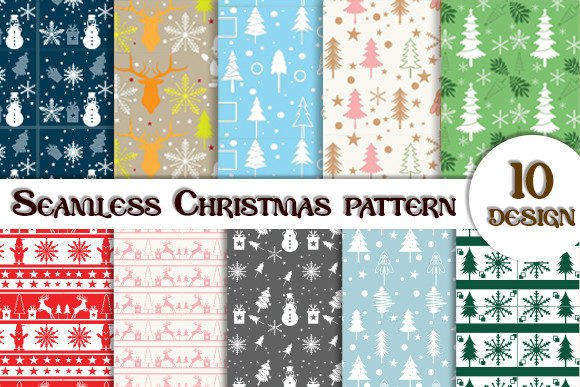
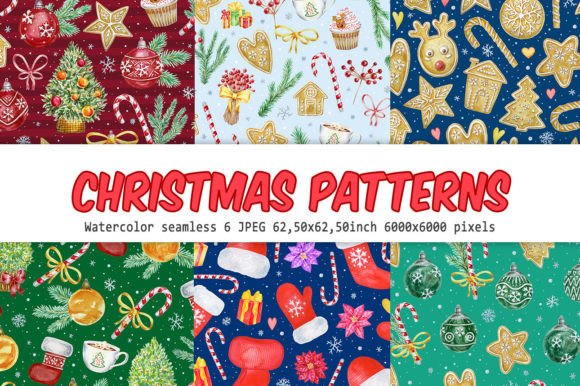
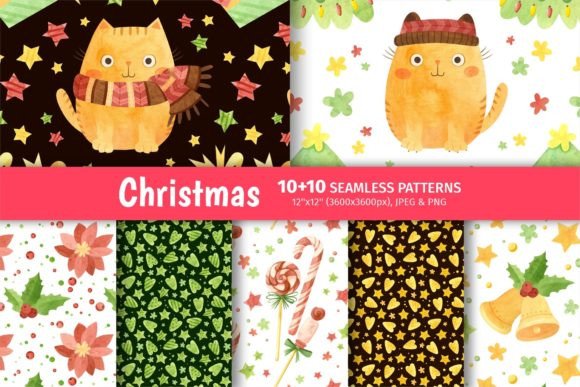
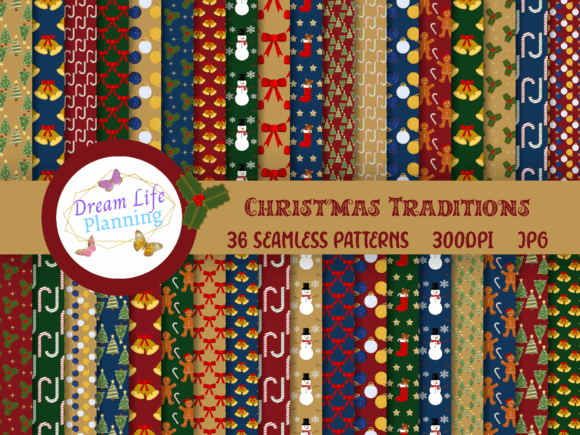
If you're crafting holiday cards, designing print-on-demand mugs or tote bags, assembling a nostalgic junk journal, or preparing invitations for a retro-themed Christmas party—Christmas Traditions Seamless Patterns is built for exactly that. This collection delivers 36 high-resolution, 12×12 inch seamless patterns at 300 dpi in JPG format, each brimming with timeless festive motifs: snowmen and delicate snowflakes, gingerbread couples, plush teddy bears wearing Santa hats, candy canes, holly sprigs with glossy berries, gold bells, red ribbons, and classic Christmas stockings. The palette leans into rich, warm nostalgia—deep navy, forest green, velvety red, and shimmering gold—making it ideal for both elegant and playful holiday projects.
What People Often Overlook (and Why It Matters)
Many crafters download seamless pattern packs without checking two critical things: resolution compatibility and intended use context. For example, someone ordering Christmas Traditions Seamless Patterns for a large-format book cover may assume the 12×12 inch size will scale cleanly to 8.5×11 or A4—but without verifying how the pattern repeats visually at smaller dimensions, they risk awkward cropping or misaligned motifs near page edges. Likewise, designers using these for fabric printing sometimes forget that digital glitter or foil effects included in some patterns are purely visual enhancements. They won’t translate to physical texture on printed fabric, vinyl, or paper—only to screen-based mockups or digital presentations.
This isn’t a flaw in the design—it’s a mismatch between expectation and medium. When a small business owner uses a “gold foil” bell pattern for a greeting card and then prints it on matte stock, the result looks flat—not faulty, just unoptimized. The same applies to scrapbookers who layer multiple glitter-heavy patterns: what reads as festive on screen can become visually noisy on paper, especially when combined with embossing or ink blending.
Avoiding the “Seamless ≠ Universal” Assumption
“Seamless” means the pattern tiles smoothly edge-to-edge—but it doesn’t guarantee suitability for every surface or scale. One common oversight is applying these patterns directly to curved surfaces (like mug wraps or ornament templates) without testing the repeat alignment first. A snowflake motif that flows perfectly across a flat invitation may distort or create unintended gaps when wrapped around a cylindrical shape. Always test your pattern on a mockup template—or better yet, use vector-based tools (like Adobe Illustrator’s Pattern Tool) to adjust spacing before final export.
Another frequent hiccup? Assuming all 36 patterns work equally well for text-heavy layouts. Patterns with dense elements—like overlapping candy canes or clustered holly—can compete with body copy or headlines. If you’re designing a Christmas newsletter or printable planner page, try pairing busier patterns with solid-color borders or using them only as subtle background textures behind light-colored text boxes.
Choosing the Right Pattern for Your Project Type
Not all 36 patterns serve the same purpose—and that’s intentional. Here’s how to match them wisely:
- For POD products: Prioritize lower-contrast repeats (e.g., subtle gold bells on navy or soft snowflakes on cream) to ensure consistency across varied materials—from ceramic mugs to cotton tees. Avoid overly detailed patterns like intricate gingerbread lace if your printer has limited color fidelity.
- For scrapbooking & junk journals: Lean into tactile-friendly designs—think bold red ribbons or chunky candy canes—that hold up when layered with washi tape, vellum, or hand-lettered tags. These read clearly even when partially obscured.
- For digital presentations or social graphics: Use the glitter/foil-enhanced patterns intentionally—on headers, Zoom backgrounds, or Instagram story highlights—where their luminous quality shines without physical limitations.
- For printed invitations & stationery: Stick with crisp, high-contrast combos (e.g., white snowflakes on deep blue) for clean laser or inkjet output. Test one pattern at actual print size before bulk printing.
Before You Download or Purchase
Take three quick checks to protect your time and budget:
- Confirm file format and resolution: These are JPGs at 300 dpi—ideal for print—but not editable vectors. If you need to recolor individual elements (e.g., change a holly berry from red to burgundy), you’ll need the matching clipart set available separately in the Dream Life Planning shop.
- Review the embellishment note: Some patterns include digital glitter or foil. If your workflow relies on physical texture (e.g., foil-stamping services or glitter glue application), treat those files as visual guides—not production-ready assets.
- Check licensing scope: These patterns are licensed for personal and commercial use—including POD—but always verify current terms in the product listing. Reselling the patterns themselves (as standalone digital downloads) or claiming them as your original design violates standard usage rights.
Realistic Examples of Better Decisions
A freelance designer creating holiday packaging for a small-batch cookie brand chose the “Gingerbread Man and Lady” pattern—not for the full wrap, but as a repeating border along the bottom third of her box template. She paired it with a solid kraft background and minimalist typography. Result? Festive but legible, nostalgic but not kitschy.
A teacher making classroom Christmas bookmarks used the “Teddybear and Santa Hat” pattern at 50% opacity as an underlay beneath student-drawn illustrations. The warmth of the design came through without overwhelming children’s artwork.
Meanwhile, a blogger promoting seasonal journaling templates avoided the most glitter-dense files for her printable PDFs—opting instead for the “Holly and Berries” pattern in muted green-on-cream. Her readers reported easier readability and smoother printing—even on home printers.
Final Thought: Quality Starts With Intentional Use
Christmas Traditions Seamless Patterns isn’t just about quantity—it’s about thoughtful repetition. Each of the 36 patterns offers cohesion, color harmony, and craft-friendly scaling—but only if matched to your medium, audience, and end goal. Whether you're launching a holiday product line or hand-making gifts for loved ones, spend five minutes previewing how a pattern behaves at your target size and surface. That small step prevents rework, preserves print quality, and keeps your creative energy where it belongs: on what you make next—not on fixing avoidable oversights.