Mushroom Lawn Patterns: A Handcrafted Digital Asset for Playful, Festive Design
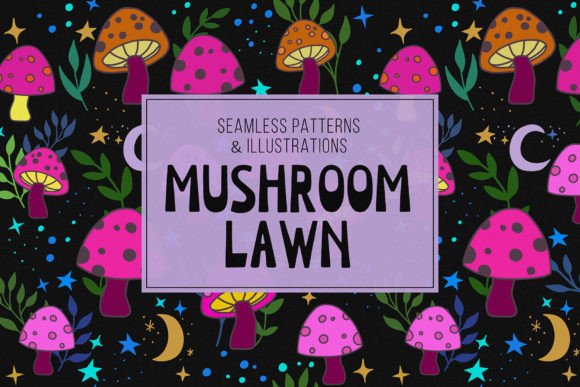
Mushroom Lawn Patterns is a curated digital illustration set designed for creators who value charm, cohesion, and versatility in visual assets. Unlike algorithmically generated or photorealistic pattern libraries, it leans into intentional handmade aesthetics—think soft linework, gentle color gradients, and whimsical motifs like mushrooms, crescent moons, stars, and stylized foliage. Each element is drawn with expressive imperfection, giving the collection a tactile, storybook-like warmth that stands out in both print and digital contexts.
What Sets Mushroom Lawn Patterns Apart
The distinction lies not just in subject matter but in execution and intent. Many nature-themed pattern packs prioritize scalability or realism; Mushroom Lawn Patterns prioritizes mood and narrative resonance. Its illustrations are built around rhythm and repetition without sacrificing individual character—each mushroom has subtle variation in cap shape and stem tilt, each star carries a slight asymmetry, and the moon motifs shift gently between phases. This attention to organic nuance helps avoid the “cookie-cutter” fatigue common in mass-produced seamless patterns.
Technically, the set delivers flexibility through layered, editable source files: EPS, PSD, SVG, and PNG formats ensure compatibility across vector-based workflows (e.g., logo adaptation, scalable branding) and raster-based editing (e.g., social media banners, mockups). The inclusion of high-resolution JPGs (300 dpi) also supports immediate print use—no re-rendering or interpolation needed. That dual-path support—editable sources *and* ready-to-deploy raster outputs—is uncommon at this level of stylistic specificity.
Comparing Approaches: Handmade vs. Generative vs. Photographic Patterns
Designers evaluating pattern resources often weigh three broad categories: hand-drawn collections like Mushroom Lawn Patterns, AI-generated pattern tools, and photographic or scanned texture-based assets.
- Hand-drawn sets (e.g., Mushroom Lawn Patterns) offer strong stylistic consistency and emotional tone—but require more deliberate curation. They’re ideal when brand voice hinges on warmth, nostalgia, or gentle playfulness—think children’s book publishers, indie stationery brands, or wellness-focused product packaging.
- AI-generated pattern tools excel in speed and variation: users can iterate dozens of colorways or scale adjustments in seconds. However, they often lack the subtlety of intentional negative space, inconsistent line weight, or motif hierarchy that gives Mushroom Lawn Patterns its fairy-tale readability. Output may feel polished but impersonal—less “designed,” more “computed.”
- Photographic or scanned textures bring authenticity and depth, especially for natural materials like moss or bark. Yet they rarely achieve true seamlessness without heavy editing, and scaling introduces pixelation or visible tiling artifacts. Mushroom Lawn Patterns avoids those constraints entirely by being vector-first and purpose-built for repeat.
This isn’t about superiority—it’s about fit. If your project needs rapid experimentation across dozens of themes, generative tools have merit. If you’re designing a luxury botanical skincare line where texture realism matters most, scanned elements may suit better. But if you need a cohesive, joyful, and instantly recognizable visual language—especially one that reads well across stickers, apparel, and web backgrounds—Mushroom Lawn Patterns fills a specific, well-executed niche.
Practical Use Cases and Real-World Fit
Mushroom Lawn Patterns works best where thematic alignment and emotional resonance carry measurable impact. Consider these examples:
- A small-batch greeting card company uses the moon-and-mushroom motif as a recurring background on holiday cards—its festive yet calm tone appeals across age groups, unlike overly bright or cartoonish alternatives.
- An independent yoga studio incorporates the star-and-plant variation into digital class schedules and printable wall posters. The soft palette (muted sage, dusty lavender, warm cream) complements mindfulness branding without visual clutter.
- A craft supplies brand licenses the SVG files to develop iron-on transfers for tote bags and aprons. Because each motif is individually layered and named in the vector file, designers can easily isolate stems, caps, or leaves for custom arrangements—something flat PNG-only packs don’t allow.
These applications succeed because Mushroom Lawn Patterns was conceived with cross-format utility in mind—not as decoration alone, but as functional design infrastructure. That said, it’s not universally optimal. Projects requiring strict corporate identity compliance (e.g., financial services, legal tech) may find its playfulness misaligned with audience expectations. Similarly, large-scale environmental graphics—billboards, trade show backdrops—may benefit more from ultra-minimalist or typographic systems than illustrative density.
Tradeoffs to Acknowledge
No resource is frictionless. Mushroom Lawn Patterns assumes a baseline comfort with Adobe Illustrator or Photoshop—particularly for editing EPS or PSD layers. Beginners relying solely on Canva or free-tier tools may face limitations accessing full editability, though the included JPG and PNG files remain usable for basic placement. Also, while the five color variations are thoughtfully balanced, they aren’t infinitely adjustable: swapping a single hue across all motifs requires manual recoloring unless using global swatches in Illustrator. Users expecting one-click color-theming across all 5 templates may need to budget extra time.
Another consideration is motif density. The patterns lean toward medium-to-high coverage—ideal for backgrounds and fabric prints, but potentially overwhelming for UI elements like app icons or small-scale buttons. In those cases, extracting and simplifying individual elements (e.g., using just one mushroom icon as a favicon) becomes necessary—and the clean vector construction makes that feasible, but not automatic.
When to Choose Mushroom Lawn Patterns—and When to Look Elsewhere
Mushroom Lawn Patterns is a strong match if you:
- Need a cohesive, emotionally resonant visual system for seasonal or celebratory projects;
- Prefer hand-crafted authenticity over algorithmic uniformity;
- Work across both print and digital deliverables and require reliable scalability;
- Have access to Adobe Creative Cloud or similar vector/raster editors;
- Value clear file organization and motif isolation for future customization.
It may be less suitable if you:
- Require photorealistic botanical accuracy (e.g., scientific illustration, horticultural branding);
- Need extensive multilingual or culturally specific symbolism beyond universal nature motifs;
- Are building a strictly monochrome or high-contrast accessibility-first interface;
- Lack editing software and rely exclusively on drag-and-drop platforms with limited layer support.
Ultimately, Mushroom Lawn Patterns reflects a particular design philosophy—one that treats illustration not as ornament, but as atmosphere. It doesn’t try to do everything. Instead, it does one thing well: invite warmth, wonder, and quiet celebration into everyday design work. That focus makes it valuable not as a generic toolkit, but as a considered choice—when the right context aligns, its handmade magic holds up under real-world use.