Colorful Plaid Geometric Patterns: A Practical Guide for Designers and Makers
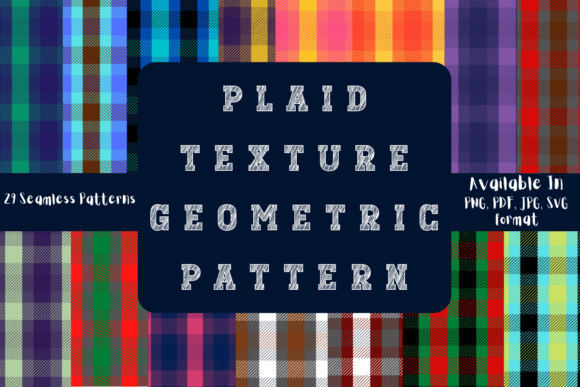
Colorful Plaid Geometric Patterns is a curated digital collection of 29 original, high-resolution pattern designs that merge the structured rhythm of plaid with bold geometric forms—think intersecting grids, layered tessellations, angular repeats, and asymmetrical color blocks. Unlike generic plaid or basic geometric assets, these patterns are intentionally composed to balance visual energy with repetition integrity, making them suitable for both large-scale applications (like wallpaper or fabric printing) and detailed craft work (such as embroidery templates or vinyl decals).
What Sets These Patterns Apart
Not all plaid or geometric pattern sets deliver equal versatility—and this is where Colorful Plaid Geometric Patterns distinguishes itself. Each design is built from scratch using vector-based workflows, ensuring crisp scalability across formats. The collection includes JPG, PNG, SVG, and EPS files—all at 4000px × 4000px and 300 dpi—so users can adapt seamlessly between screen-based mockups, print production, and cutting-machine workflows.
The color palettes are thoughtfully balanced: no single hue dominates, and contrast ratios meet accessibility standards for legibility in UI overlays or textile previews. More importantly, the geometry isn’t purely decorative—it’s engineered for repeat integrity. You won’t encounter misaligned seams or inconsistent spacing when tiling across large surfaces like curtains or rugs. That attention to technical execution matters whether you’re prepping files for a local print shop or uploading to an on-demand platform like Spoonflower or Printful.
How It Compares to Other Pattern Resources
Digital pattern libraries fall into several broad categories: royalty-free stock pattern sites, AI-generated pattern tools, hand-drawn indie collections, and open-source design repositories. Colorful Plaid Geometric Patterns sits between the curated quality of premium indie bundles and the functional reliability of professional-grade assets—without the licensing ambiguity or generative unpredictability found elsewhere.
Stock platforms often offer thousands of patterns, but filtering for true plaid-geometric hybrids—especially ones that avoid clichéd tartan mimicry or overly rigid symmetry—is time-consuming. Many results prioritize aesthetics over technical readiness: low-res JPGs, missing vector variants, or unclear usage terms. In contrast, this collection delivers consistency out of the gate: uniform dimensions, consistent DPI, and format redundancy (SVG for web, EPS for legacy design apps, PNG with transparency for layering).
AI pattern generators can produce novel arrangements quickly, but they rarely guarantee seamless tiling or color harmony across multiple variations—and they almost never include production-ready file types. If you need one-off experimentation or rapid prototyping, those tools have value. But if your goal is reliable, repeatable output for physical products—say, a batch of custom throw pillows or a limited-run fabric line—Colorful Plaid Geometric Patterns reduces risk by providing tested, ready-to-use files.
Real-World Use Cases and Practical Fit
This collection shines in projects where visual cohesion and technical precision matter equally. For example:
- Home décor makers use the patterns for digitally printed curtains and cushion covers—especially when matching accent pieces across rooms without needing custom dye-lot coordination.
- Small-batch apparel designers apply them to tote bags, scarves, or reversible jackets where geometric structure enhances garment drape and pattern alignment.
- Educators and workshop leaders incorporate the SVG files into lesson plans on symmetry, tessellation, or color theory—students can import, recolor, and manipulate vectors directly in free tools like Inkscape.
- DIY crafters scale individual motifs for stencils, Cricut projects, or cross-stitch charts—PNGs with transparent backgrounds simplify isolation and resizing.
It’s also useful for designers working under tight timelines. Because all 29 patterns share the same technical specs, swapping one for another in a layout doesn’t require reformatting, resampling, or resolution checks. That uniformity saves hours across multi-pattern projects—like designing a coordinated nursery set (blanket + rug + wall art) or a branded merch line (tote + notebook + enamel pin background).
Tradeoffs and Limitations to Consider
No digital asset library is universally optimal—and Colorful Plaid Geometric Patterns has clear boundaries. It is not a subscription service, nor does it offer ongoing updates. You receive exactly 29 patterns, with no additional variants, seasonal additions, or customization support. If your workflow depends on frequent stylistic shifts—say, rotating themes quarterly for social media merch—you’ll need to supplement this collection with other sources.
It also assumes a baseline level of design software familiarity. While PNGs work in most photo editors, full utilization of SVG and EPS files benefits from vector-capable tools (Adobe Illustrator, Affinity Designer, or even free alternatives like Vectr). Users relying solely on Canva or basic mobile apps may find less immediate utility—though PNGs still serve well for simple overlays or print-on-demand uploads.
Another consideration: the aesthetic leans intentionally vibrant and contemporary. If your brand identity prioritizes muted tones, monochrome minimalism, or organic textures (like watercolor or linen grain), these patterns may sit outside your established palette. They’re designed to stand out—not fade into the background.
When It’s the Right Choice—and When It’s Not
Colorful Plaid Geometric Patterns is strongest when you need:
- A known quantity—29 distinct, production-ready patterns with no guesswork about resolution, licensing, or tiling behavior;
- Consistency across multiple applications—same file specs mean fewer compatibility surprises when moving from screen to fabric to paper;
- Design flexibility without generative uncertainty—each pattern is human-crafted, so proportions, spacing, and rhythm reflect intentional decisions rather than algorithmic defaults.
It’s less ideal if you require:
- Custom color adjustments per pattern (the files are delivered as-is; recoloring requires vector editing skills);
- Extensive motif variation (e.g., 50+ colorways per base design or scaled-down sub-patterns for embroidery);
- Commercial licenses covering resale of unmodified digital files (this collection permits use in physical end products, but not redistribution of the source files themselves).
Making an Informed Decision
Before choosing any pattern resource, ask three questions: What’s the end use? What tools will I use to implement it? And how much time can I invest in prep versus execution?
If your answer involves printing on textiles, producing physical goods, or maintaining visual continuity across multiple items—and you prefer predictable, editable assets over experimental but unstable outputs—Colorful Plaid Geometric Patterns aligns well with those goals. Its value lies not in sheer volume, but in coherence: 29 patterns that behave the same way, look distinct from one another, and hold up under real-world production demands.
That said, it’s not a replacement for broader creative exploration. Pair it with texture libraries for depth, or typography resources for label design. Think of it as a dependable foundation—not the entire toolkit.
Ultimately, the best pattern resource supports your process, not your browser history. Colorful Plaid Geometric Patterns serves makers who value clarity, consistency, and craftsmanship in equal measure—and who understand that strong design starts with reliable building blocks.