Seamless Crab Patterns: A Practical Guide for Designers and Crafters
Seamless crab patterns are digital design assets—typically high-resolution JPEG files—that tile without visible seams, enabling continuous coverage across surfaces like fabric, wallpaper, web backgrounds, or packaging. Unlike hand-drawn illustrations or photographic crab motifs, seamless versions are engineered for repetition: edges align precisely so that when repeated horizontally and vertically, the pattern flows naturally, with no breaks or misaligned joints. This technical precision makes them especially valuable for print-on-demand services, textile designers, and digital artists working on scalable projects.
What Makes Seamless Crab Patterns Distinct?
The defining trait of Seamless Crab Patterns isn’t just subject matter—it’s functional geometry. Each pattern is constructed using careful edge-matching techniques: the left edge mirrors the right, the top matches the bottom, and corners align seamlessly across quadrants. This isn’t achieved by simple cropping or cloning; it involves deliberate placement of crab silhouettes, negative space, scale variation, and rhythmic spacing to preserve visual interest across infinite tiling.
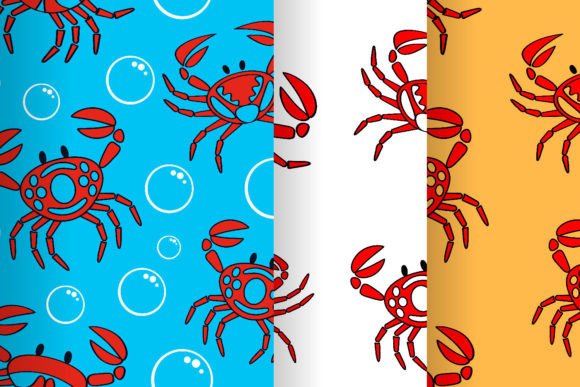
“Seamless crab patterns 3 in 1” refers to a curated ZIP archive containing three distinct variations—often differing in density, orientation, or stylistic treatment (e.g., minimalist line art, shaded realism, or stylized vector-inspired rendering). These aren’t mere duplicates with adjusted brightness; they represent thoughtful alternatives designed for different applications: one may suit apparel printing where fine detail must survive fabric stretch, another may optimize for large-scale wall murals where subtlety reads better at distance, and a third may prioritize contrast for embroidery digitization or screen printing.
How It Compares to Other Pattern Types
Compared to generic ocean-themed patterns, Seamless Crab Patterns offer specificity without sacrificing versatility. A broad “sea life” pattern might mix starfish, coral, and shells—useful for thematic cohesion but less effective if your project centers exclusively on crabs as a motif (e.g., a coastal restaurant brand identity or a marine biology education kit). In contrast, Seamless Crab Patterns maintain consistent iconography while allowing for tonal and compositional variety.
When weighed against fully editable vector patterns (like SVG or AI files), JPEG-based Seamless Crab Patterns trade editability for immediacy and reliability. Vectors allow resizing without loss and color adjustments in software like Adobe Illustrator—but require design literacy and time to adapt. JPEGs, especially high-resolution ones (300 DPI or higher), deliver plug-and-play usability: drag into Canva, upload to Spoonflower, or import into Cricut Design Space with minimal prep. For users prioritizing speed over customization—or those working within platforms that don’t support vector imports—JPEGs are often the more practical choice.
Strengths and Real-World Fit
One strength lies in predictability. Because these patterns are pre-tested for tiling integrity, users avoid common pitfalls like mismatched edges or moiré effects that can emerge when manually repeating raster images. That reliability matters most in production environments—especially when ordering physical goods. A textile printer won’t reject a file for seam misalignment, and a print shop won’t need to reprocess artwork due to hidden tiling errors.
Another advantage is resolution fidelity. High-resolution JPEGs (e.g., 6000 × 6000 pixels) retain clarity even when scaled to cover a 10-foot banner or printed on a yard of linen. This contrasts with low-DPI web graphics, which pixelate under enlargement, or overly compressed files that introduce artifacts around crab claws or shell textures.
Realistic use cases include:
- A small-batch clothing brand developing limited-edition swim trunks—using one pattern for main fabric and a second, lower-contrast variant for pocket linings;
- An educator creating printable marine science worksheets—selecting a simplified crab pattern for younger students and a more detailed version for advanced anatomy lessons;
- A home decorator sourcing wallpaper for a coastal-themed nursery—choosing the “3 in 1” ZIP to test how each variant interacts with room lighting and furniture tones before committing to full rolls.
Tradeoffs and Limitations
The primary limitation is format rigidity. JPEGs are flat, RGB-only files. You cannot isolate individual crabs for rearrangement, adjust transparency per element, or convert colors non-destructively. If your workflow requires CMYK output for commercial offset printing, you’ll need to convert the file externally—and may lose some vibrancy depending on the source profile. Similarly, if accessibility is a priority (e.g., for users relying on screen readers), JPEGs lack semantic structure; alt text must be added separately in publishing tools.
There’s also a contextual constraint: Seamless Crab Patterns assume a certain aesthetic alignment. They work well within nautical, tropical, artisanal, or playful design systems—but may feel out of place in minimalist Scandinavian interiors, corporate financial branding, or high-tech medical contexts. Their charm is intentional and specific—not universal.
When to Choose Seamless Crab Patterns—and When Not To
Choose Seamless Crab Patterns if you need reliable, production-ready tiling with zero setup overhead, especially when working under deadline pressure or with limited design software access. They’re particularly appropriate when consistency matters more than granular control—such as licensing assets for multiple internal teams or embedding into templated marketing materials.
Consider alternatives if your project demands:
- Dynamic recoloring: If you plan to generate dozens of color variants (e.g., for A/B testing product mockups), vector or layered PSD files give far more flexibility;
- Adaptive scaling across devices: For responsive web backgrounds where resolution independence is critical, CSS-generated patterns or SVG tiles may perform more efficiently than large JPEGs;
- Custom integration: If you’re building a generative design tool or plugin that places crabs algorithmically based on user input, raw assets won’t suffice—you’d need parametric source files or APIs.
Also note: “Seamless crab patterns 3 in 1” doesn’t imply automatic compatibility with every platform. Some POD services impose file dimension limits (e.g., 10,000 px max width), and certain embroidery software expects specific DPI ranges or embedded color palettes. Always verify technical requirements before purchase or deployment.
Making an Informed Decision
Evaluating Seamless Crab Patterns isn’t about finding the “best” option—it’s about matching asset properties to your constraints and goals. Ask yourself:
- What’s my primary output medium? (Fabric, paper, screen, vinyl?)
- Do I need to modify colors, scale, or layout after download—or is final appearance fixed at export?
- How much time can I allocate to file preparation versus creative execution?
- Will others reuse this asset? If so, does the license permit redistribution or sub-licensing?
Look beyond resolution numbers. Examine sample tiles at 100% zoom: do crab legs intersect cleanly across edges? Does the rhythm feel balanced—not too dense to read, not so sparse that repetition becomes obvious? Test one pattern in your actual workflow before scaling to bulk use. Many creators find value in starting with a single high-quality JPEG, then expanding to multi-variant bundles only after confirming fit.
Ultimately, Seamless Crab Patterns serve a precise niche: dependable, visually cohesive, ready-to-deploy tiling for crab-centric design work. They reflect a balance between craft and utility—designed not to dazzle with novelty, but to function consistently across real-world applications. Whether you’re iterating on a logo system, prototyping packaging, or refreshing a website’s visual language, their value emerges most clearly when matched thoughtfully to what your project actually needs—not what it might ideally want.